Halawet El Jibn Recipe
Halawet El Jibn has been one of my favorite desserts since childhood. My mother used to bring it home for Eid, so we always knew we had something delicious to look forward to. Sometimes, she would surprise us with it even when there was no special occasion.

If you have no idea what Halawet El Jibn tastes like, imagine something like a Twinkie, but richer and more flavorful. Instead of sponge cake, the creamy filling is wrapped in a soft semolina and cheese layer, almost like a thick crepe.
For my homemade version, I use mozzarella cheese and a creamy ricotta filling that tastes very close to ashta. I also use vanilla instead of rose water because my family prefers it that way.
The recipe is straightforward, but there are a few things worth knowing about the cheese dough, especially when melting the mozzarella and rolling it around the filling.
What Is Halawet El Jibn?
Halawet El Jibn (حلاوة الجبن) is a traditional Middle Eastern dessert made with a soft cheese-and-semolina dough wrapped around a creamy filling. The rolls are cut into individual pieces, garnished with pistachios, and served with sugar syrup.
The name means sweetness of cheese in Arabic. The dessert is especially associated with Syria and is enjoyed across the Levant.
Traditional versions are often filled with ashta, an Arabic-style cream, and flavored with rose water or orange blossom water.
My version uses a homemade ricotta filling and vanilla. It has the creamy richness I enjoy in Halawet El Jibn
Why I Make the Filling with Ricotta
Traditional ashta takes time to make, and some ready-made versions I’ve tried have been too thin or flavored with rose water.
Instead, I make a filling with milk, cornstarch, and unsalted ricotta cheese. It’s rich and creamy, but not runny. The taste and texture are so close to ashta that I can hardly tell the difference.
I use my homemade ricotta cheese for this recipe. Use ricotta without added salt so the filling tastes right in a sweet dessert.

Ingredients You’ll Need
For the creamy filling
- Cornstarch (corn flour): Thickens the milk and helps the filling hold its shape inside the rolls.
- Milk: Forms the creamy base of the filling.
- Unsalted ricotta cheese: Adds richness and gives the filling a texture similar to ashta. I use my homemade ricotta cheese.
For the cheese dough
- Mozzarella cheese: I use shredded mozzarella because it melts quickly in the semolina dough.
- Fine semolina: Combines with the melted cheese to form the soft outer layer. Use fine semolina, not coarse semolina.
- Sugar: Sweetens the dough.
- Unsalted butter: Adds richness and is also useful for lightly greasing your hands and rolling pin when shaping.
- Vanilla extract: I use vanilla because my family isn’t fond of rose water. You can use rose water instead if you prefer the traditional flavor.
- Water: Used to cook the semolina and bring the cheese dough together.
For serving
- Pistachios: Crushed or sliced pistachios add a little crunch and look beautiful against the pale cheese rolls.
- Sugar syrup: Drizzle it over the dessert just before serving. The syrup adds sweetness and moisture.
How to Make Halawet El Jibn
1. Prepare the creamy filling
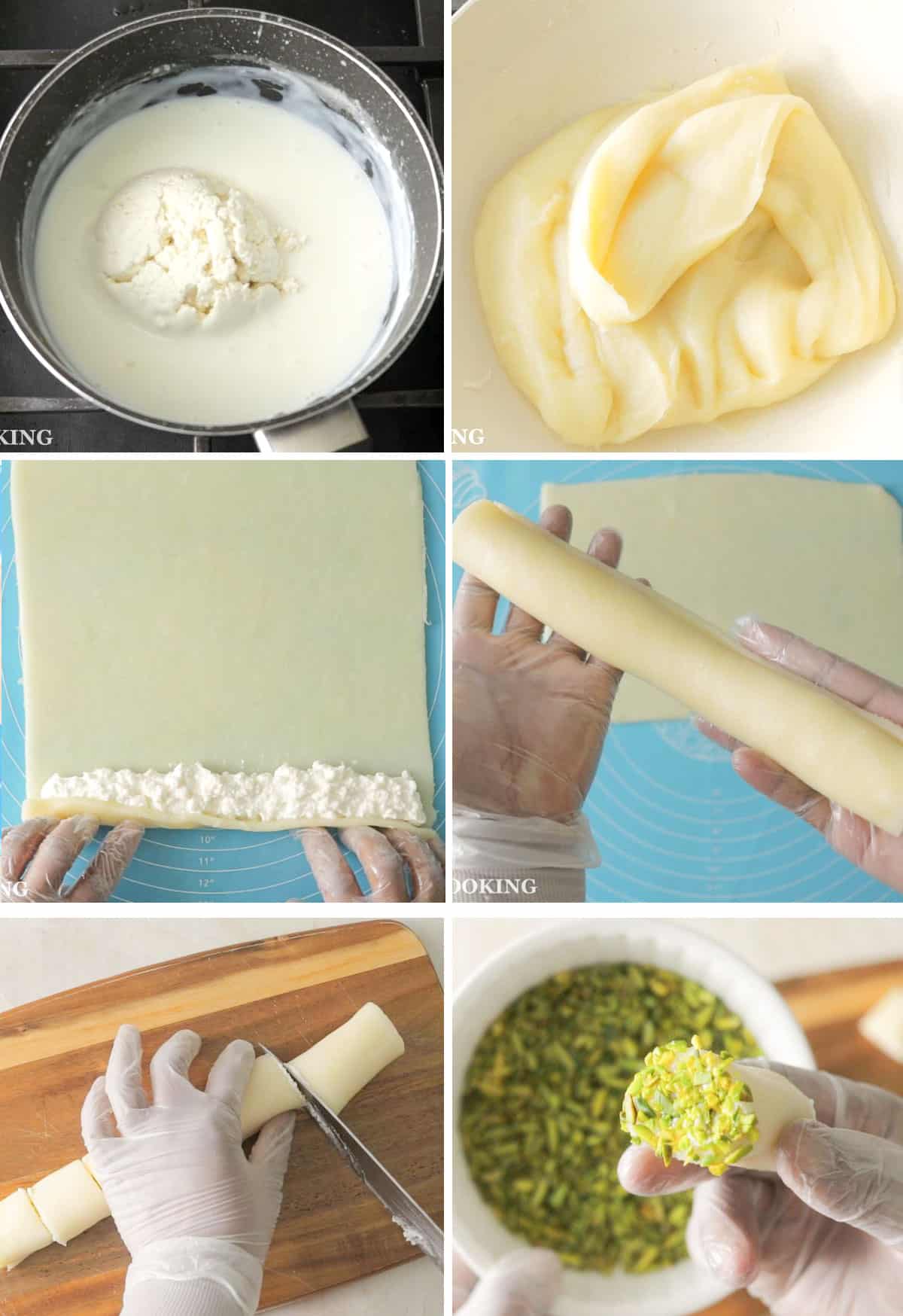
In a saucepan, combine the cornstarch and milk off the heat. Stir until the cornstarch dissolves.
Turn on the heat and keep stirring until the milk mixture thickens. Add the unsalted ricotta and stir for another minute.
Transfer the filling to a plate and let it cool to room temperature. Cover and refrigerate while you prepare the cheese dough.
The filling should be creamy and thick enough to stay in place when you roll the dessert. It will firm up a little more as it cools.
2. Cook the semolina mixture
Pour the water into a large pan and heat it. Add the sugar and stir until dissolved.
Keep the heat at medium-low, add the butter, and let it melt.
Gradually add the fine semolina, stirring continuously until the mixture becomes very thick. Stir in the vanilla.
3. Add the mozzarella in two stages
Add half of the shredded mozzarella to the thick semolina mixture. Use a spatula to cover the cheese with the hot mixture.
Turn off the heat, cover the pan, and leave it for two minutes. This gives the mozzarella time to soften and melt without turning grainy.
Uncover the pan, add the remaining mozzarella, and mix.
I add the cheese in two stages because the semolina mixture is already quite thick. Adding all the mozzarella at once makes it harder to incorporate and takes longer to melt.
Turn the heat back on and continue mixing until the cheese is fully incorporated and the mixture forms a smooth, stretchy dough.
Don’t worry if mixing feels difficult at first. The dough is thick, and it takes some effort to bring the melted cheese and semolina together.
4. Roll out the cheese dough
Transfer the warm dough to your work surface and knead it briefly.
The finished dough should be smooth, pliable, and easy to shape without being sticky. You should be able to form it into a ball or roll it out without difficulty.
Divide the dough into two equal portions. Keep one covered while working with the other.
Lightly butter your hands, work surface, and rolling pin.
Roll the first portion into a rectangle approximately 11 × 9 inches and about ½ cm thick. Trim the uneven edges to make a neat rectangle.
The dough should be thin enough to fold smoothly around the filling, but not so thin that it tears.
5. Fill and shape the rolls
Place a strip of the chilled ricotta filling along the long edge of the rectangle closest to you.
Roll the dough over the filling twice to enclose it in a smooth log.
Cut along the length of the roll to separate the filled log from the remaining sheet of dough, then set it aside.
Add another strip of filling to the remaining dough and repeat to make a second log.
Roll out the other half of the cheese dough and repeat the process. You should have four filled logs altogether.
6. Chill and slice
Cover the logs with plastic wrap and refrigerate them for at least one hour. I prefer leaving them for about two hours. Chilling the logs helps the filling firm up so it stays inside the rolls when you cut them.
Once chilled, cut each log into pieces approximately 2½–3 inches long.
7. Garnish and serve
Dip one end of each piece into crushed pistachios and arrange the rolls on a serving plate.
Drizzle with sugar syrup just before serving.
Tips for Making Halawet El Jibn
- Use fine semolina. The semolina should mix smoothly with the melted cheese to form the dough.
- Add the mozzarella in two batches. The semolina mixture becomes quite thick, so adding the cheese gradually makes it easier to incorporate.
- Work with the dough while it’s warm. The dough remains workable as it cools, but it becomes a little harder to roll and shape.
- Don’t overfill the rolls. You want enough cream for a generous filling, but not so much that it escapes when rolling.
- Give the logs time to chill. At least one hour in the refrigerator helps the filling firm up. Two hours works well for me.
- Add the syrup when serving. This lets you enjoy the soft cheese layer, creamy filling, and syrup’s sweetness together.

Related Recipes
- Graybeh, melt-in-your-mouth cookies.
- Aish el Saraya.
- Kunafeh.
- Barazek.
- Authentic date cookies.
- Kahk.
- Maamoul Filled Cookies.
⭐PLEASE RATE AND REVIEW
If you have tried this Halawet El Jibn Recipe and liked it, please give it a 5-star rating and leave a comment below with your experience!

Halawet El Jibn
Ingredients
For the creamy filling
- 3 tablespoons cornstarch corn flour
- 2 cups milk
- ¾ cup unsalted ricotta cheese preferably homemade
- For the cheese dough
- 2 cups water
- 1 cup sugar
- ¾ cup fine semolina
- 1 tablespoon unsalted butter
- 2 cups shredded mozzarella cheese
- 2 teaspoons vanilla extract or rose water
For the garnish
- ½ cup crushed or sliced pistachios
For serving
- 1 cup prepared sugar syrup
Instructions
Make the filling
- In a medium saucepan with the heat turned off, mix the cornstarch and milk until smooth.
- Turn on the heat and stir continuously until the mixture thickens.
- Add the unsalted ricotta cheese and stir for one minute.
- Transfer to a plate, cool to room temperature, then cover and refrigerate.
Make the cheese dough
- Heat the water in a large pan. Add the sugar and stir until dissolved.
- Reduce the heat to medium-low. Add the butter and let it melt.
- Gradually add the fine semolina, stirring until the mixture becomes very thick. Mix in the vanilla.
- Add half the mozzarella and cover it with the hot semolina mixture using a spatula. Turn off the heat, cover the pan, and leave for two minutes.
- Uncover, add the remaining mozzarella, and mix. Turn the heat back on and continue stirring until the cheese is fully incorporated and the dough becomes smooth and stretchy.
Shape and fill
- Transfer the warm dough to your work surface and knead briefly. Divide it into two equal portions, keeping one covered.
- Lightly butter your hands, work surface, and rolling pin. Roll one portion into a rectangle approximately 11 × 9 inches and ½ cm thick. Trim the edges.
- Place a strip of chilled ricotta filling along the long edge closest to you. Roll the dough over the filling twice, then cut along the length of the roll to separate it from the remaining dough.
- Set the filled log aside. Repeat with the remaining sheet of dough, then with the second portion of cheese dough, to make four logs.
- Cover the logs with plastic wrap and refrigerate for at least one hour, preferably two.
- Cut the chilled logs into pieces approximately 2½–3 inches long.
Garnish and serve
- Dip one end of each piece into crushed pistachios and arrange on a serving plate.
- Drizzle with sugar syrup just before serving.
Notes
- I use homemade unsalted ricotta for the filling. Its texture and flavor are very close to ashta.
- Traditional versions often use rose water, but I prefer vanilla because my family doesn’t enjoy floral flavors in desserts.
- Add the mozzarella in two stages to make it easier to incorporate into the thick semolina mixture.
- Work with the cheese dough while warm, when it’s easier to roll.
- The filling firms up during refrigeration, making the logs easier to cut neatly.
- If you prefer a thicker filling, you can add two extra teaspoons of cornstarch to the milk mixture while cooking, or add ricotta one tablespoon at a time, as described in the original recipe notes.